
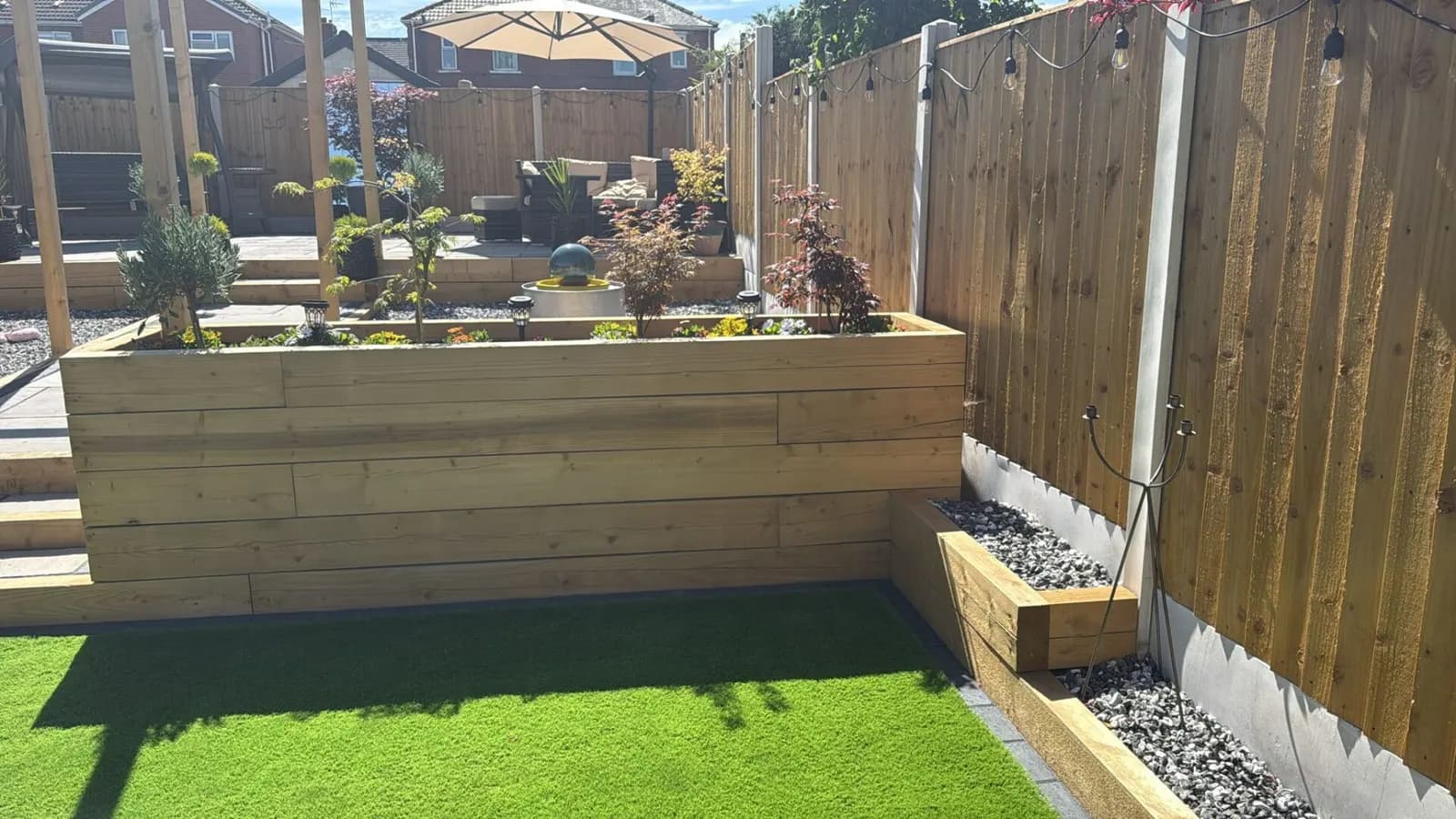
When sleeper retaining walls make sense
Sleepers are well suited to gardens that need a change of level without the footings and masonry of a brick wall. They suit a natural style, they sit well next to planting, and the job does not need bricklaying or a long curing time. A sloping lawn can become two flat terraces, and a bank can be turned into planted beds. They are also a good partner for steps and patios on different levels. Where a wall will be very tall, close to a building, or holding up a drive, brick or concrete may be a better choice.
- Terracing a sloping lawn into flat levels
- Creating a level area for a patio
- Holding back a planted bank
- Building raised beds into a slope
How a retaining wall differs from a raised bed
A raised bed only holds a small amount of soil, so its sleepers can often be stacked and fixed together. A retaining wall is different, because the whole weight of the higher ground is leaning on it, and that load gets much worse when the soil is wet. The wall needs upright posts to resist this. Those posts are concreted well into firm ground, with the sleepers fixed to them. A common rule of thumb is to put about as much post below ground as there is above it. Sleepers simply stacked on one another are rarely strong enough.
- Upright posts take the sideways pressure
- Posts concreted well below ground level
- Sleepers fixed firmly to each post
- Bottom course set on firm, level ground
Drainage is what keeps the wall standing
Rain soaking into the bank has to go somewhere, and a wall with no drainage holds it like a dam. Saturated soil is much heavier, so pressure builds during wet winters, especially in the clay soils found across much of the region. The usual solution is a layer of clean gravel behind the wall, with a membrane to protect the timber and stop soil clogging the stone. A perforated pipe at the base can carry water to a safe outlet. Leaving small gaps can also relieve pressure. This simple step costs little compared with rebuilding a wall that has leaned.
- Clean gravel backfill behind the sleepers
- Membrane between the soil and the timber
- Perforated pipe at the base where needed
- A planned outlet for the water
Choosing the right sleepers
New softwood sleepers are treated for ground contact and are the usual choice for straightforward walls. Hardwoods like oak are heavier and tend to last longer, but are harder to handle and cut. If you buy softwood, look for timber treated to Use Class 4, which is intended for ground contact. Reclaimed railway sleepers have character, but many contain creosote or tar, which can weep in warm weather, so they are best avoided around vegetable beds, seating areas and places where children play. Any cut ends should be treated, since this is where water tends to enter the timber.
- Softwood: lighter, tidy and straightforward
- Hardwood: heavier, with a longer life
- Reclaimed: full of character but check for creosote
- Treat all cut ends before they go in
How high can you go?
Low walls of a sleeper or two are simple. As height increases, the pressure at the base grows quickly, so taller walls need bigger posts, closer spacing and possibly tie-backs into the bank. As a general guide, a wall retaining much more than about a metre of soil should be looked at by a structural engineer, as should any wall with a drive, shed or building close to the top. A series of low terraces is often safer and looks better than one tall wall. We will advise honestly at your free visit: call 07860 510073 to arrange it.