Driveways
Gravel & Shingle Driveways in West Yorkshire
A budget-friendly, hard-wearing option for drives and paths, contained with block edging.
Gravel & Shingle Driveways
Gravel & Shingle Driveways by a City & Guilds approved team
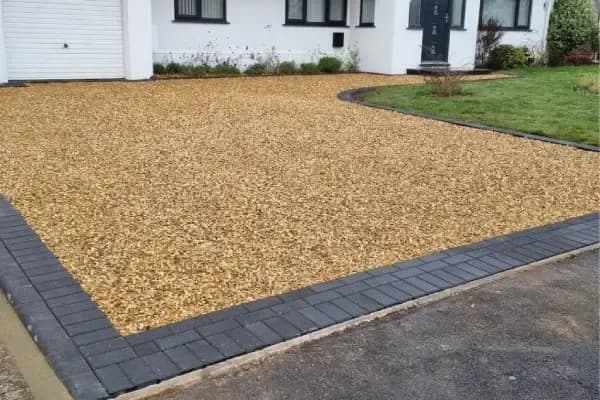
A gravel driveway is one of the most cost-effective ways to create a smart, hard-wearing parking area. Laid over a compacted base and weed membrane, and contained with block edging, gravel drains freely and gives a satisfying, traditional look.
We install gravel and shingle driveways and paths across Pontefract and West Yorkshire, and can use gravel stabilising grids to stop the stones spreading and rutting under car tyres.
Budget-friendly
One of the lowest-cost driveway options per square metre.
Naturally permeable
Rainwater drains straight through, so it is usually SuDS friendly.
Added security
The crunch underfoot makes it harder for anyone to approach your home unheard.
Neat edges
Block or kerb edging keeps the gravel where it belongs.
Should you choose gravel? An honest comparison
Loose stone works best on a rural or period property with a generous, reasonably flat parking area, where a soft crunching texture feels natural and speedy installation appeals. Long lanes are a good example, because covering a big area in paving soon becomes a major undertaking. Plenty of households should think twice, though. Pushchairs, wheelchairs and walking frames struggle on it, so anyone with mobility concerns would be happier on resin or blocks. High heels and toy scooters fare no better. Stones also follow tyres towards the highway on a sloping entrance, and leaves are a chore to clear under big trees. Expect occasional topping up and raking as part of ownership. If those trade-offs sound annoying, a fixed surface with similar drainage may repay the larger initial outlay over the years.
Gravel depth, stone shape and stabilising grids
Too much stone is the commonest mistake, as a deep layer feels like walking on a beach and traps wheels. Around 40 to 50mm over the sub-base is plenty for most cars, while a thin scatter exposes membrane within weeks. Shape counts as well. Angular chippings of 10 to 20mm lock together under load, whereas smooth pea shingle keeps rolling and migrating. Honeycomb grids solve the remaining problems by holding each stone in its own cell, which stops ruts forming where tyres turn and limits drift on gentle slopes. They only perform on a firm foundation, however, because soft ground lets the panels flex and eventually crack. Filling cells slightly above the rim hides the plastic and protects it from direct wheel contact, leaving a neat, level finish that stays put.
How it works, step by step
- Step 1
Survey & quote
We check levels and drainage and help you choose your gravel and edging.
- Step 2
Excavation & base
The area is dug out and a compacted sub-base is laid.
- Step 3
Edging & membrane
Edging is set and a weed membrane or stabilising grid is laid.
- Step 4
Gravel
Gravel is spread and levelled to the right depth for a firm finish.
FAQs
Gravel & Shingle Driveways: your questions answered
Can't see your question? Call Sean on 07860 510073 or read our general FAQs.
Will gravel spread onto my lawn and the road?
Good edging and the right depth of gravel keep it contained. Stabilising grids help even more on slopes or busy drives.
Do weeds grow through gravel?
A quality weed membrane under the gravel stops most weeds. Occasional raking and weeding keeps it tidy.
Can I upgrade a gravel drive to resin later?
Yes. A gravel drive on a good base can often be converted to resin bound later, which is a popular upgrade.