
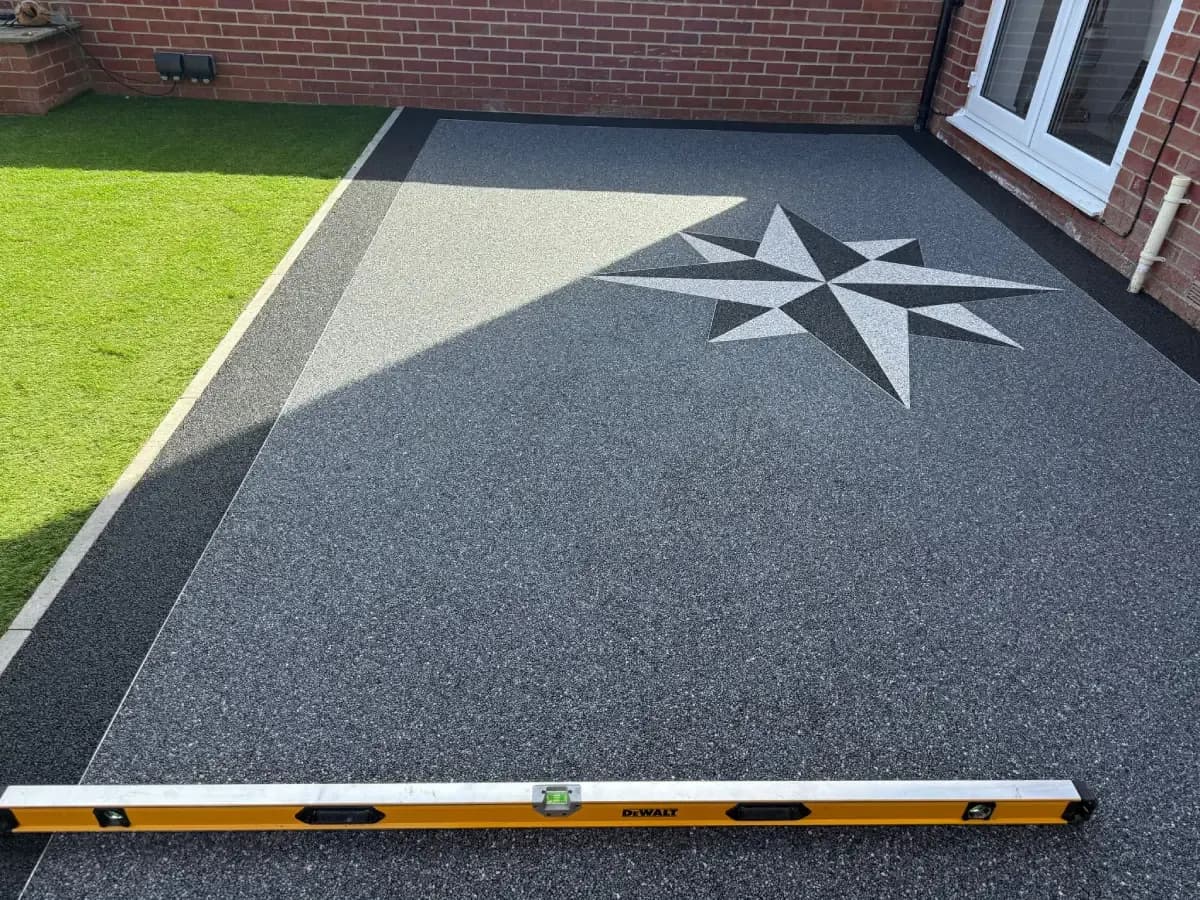
The main advantages of a resin driveway
The clearest benefit of resin bound paving is drainage, because water passes through the surface instead of running off onto the road. That usually means no planning permission is needed for the surface, even on a front garden. The finish is smooth and seamless, with no loose stones to carry into the house and no joints where weeds can root from below. It is comfortable for wheelchairs and pushchairs, and it can be designed around your home using borders, inlays and a wide choice of blends. Routine upkeep is simple, usually a sweep and a wash.
- Permeable, so rain soaks through
- No loose stones or open joints
- Smooth underfoot and under wheels
- Wide range of colours and designs
The honest downsides
Resin is not the right answer for every drive. It costs more to install than gravel, and the finish is only as good as the base under it, so any movement below can show through as a crack. A repair patch can be visible, because matching an older, weathered area is difficult, whereas a block can simply be swapped. Laying is also weather dependent, as the mix needs dry conditions, so a wet spell can delay the work. And while weeds will not come up from a good base, wind-blown seeds and moss can settle on a neglected surface.
- Higher starting cost than gravel
- Depends entirely on the base being sound
- Repairs are harder to hide than on block paving
- Cannot be laid in the wet
- Still needs sweeping and washing
Common resin driveway problems and what causes them
Most resin driveway problems come from how it was installed, not the material. Cracks usually trace back to a weak or moving base, or to laying over a surface that was already failing. Loose stones can point to a poor mix or a layer that is too thin. Yellowing is a sign of resin that is not UV-stable, and a cloudy patch can appear if moisture gets into the mix while curing. Puddles suggest that the base beneath is not draining or that silt has blocked the surface. Dry steering on a fresh surface can also leave scuffs, particularly on tight turns.
- Cracking: weak base or a failing surface beneath
- Loose aggregate: poor mix or thin application
- Yellowing: resin that is not UV-stable
- Puddles: blocked pores or a base that does not drain
- Scuffing: turning the wheel while parked on a new drive
Resin vs block paving
Comparing resin vs block paving comes down to style and how you feel about repairs. Resin gives a modern, seamless look and is permeable by nature, while standard block paving on a front garden needs drainage to a soakaway or a permeable surface beside it. Block paving wins when it comes to fixing damage, since a stained or sunken area can be lifted and relaid. It also has joints that need occasional topping up and can let weeds in. Neither is better in every case, and some of our favourite frontages use a block paved border around a resin centre.
- Choose resin for a seamless, modern finish
- Choose block for easy repairs and a traditional pattern
- Combine them for a framed, two-tone design
When resin is not the right choice
There are situations where we would steer you towards something else. If a base is unstable, it should be rebuilt first, and on a very tight budget gravel or block paving may be the better option. Drives with very steep slopes need a careful look, because the mix can be hard to hold and water behaviour changes. Heavy vehicles and repeated tight turning put more stress on the surface, so a van or trailer on the same spot every day is worth mentioning at the visit. Sean will tell you honestly if resin is not suited to your drive.
How to avoid resin driveway problems
Most of the risk disappears with careful preparation. Choose an installer who checks what is underneath the current surface, explains the base and edging, uses UV-stable resin and will not lay in the wrong weather. Afterwards, stay off the drive until the curing time you are given has passed, avoid turning the wheel while stationary, and sweep leaves and silt away so the surface keeps draining. We are a City & Guilds approved installer, fully insured, and our work comes with an installation guarantee. For a free assessment of your drive, call Sean on 07860 510073.